PQQ (pyrroloquinoline quinone) supplier specification
Nutrition BioTech is a bulk PQQ (pyrroloquinoline quinone) ingredient supplier and manufacturer, supplying PQQ disodium salt (CAS 122628-50-6) at 99% minimum by HPLC as a reddish-brown crystalline powder, for B2B nutraceutical, mitochondrial-support and healthy-aging formulation.
PQQ is supplied as the disodium salt because it is the water-soluble, handling-stable form used in finished dosage forms; the free acid (CAS 72909-34-3) is available for reference and analytical use. Every lot ships with a Certificate of Analysis stating identity, HPLC assay and the assay basis. Buyers should confirm the intended form, assay basis and serving size before sampling.
| Ingredient name | PQQ (pyrroloquinoline quinone), supplied as PQQ disodium salt — RejuveSynergy™ |
|---|---|
| Synonyms | Pyrroloquinoline quinone disodium salt; methoxatin; methoxatin disodium salt; PQQ Na2; 4,5-dihydro-4,5-dioxo-1H-pyrrolo[2,3-f]quinoline-2,7,9-tricarboxylic acid |
| CAS number | 122628-50-6 (disodium salt, the commercial ingredient form) · 72909-34-3 (PQQ free acid) |
| Machine-readable identifiers | CAS 122628-50-6 — InChIKey UFVBOGYDCJNLPM-UHFFFAOYSA-L · PubChem CID 3078772 CAS 72909-34-3 — InChIKey MMXZSJMASHPLLR-UHFFFAOYSA-N · PubChem CID 1024 |
| Molecular formula | C14H4N2Na2O8 (disodium salt) · C14H6N2O8 (free acid) |
| Molecular weight | 374.17 g/mol (disodium salt) · 330.20 g/mol (free acid) |
| Assay / purity | 99% minimum by HPLC. The assay basis (as PQQ disodium salt or as PQQ equivalent) is stated on the Certificate of Analysis for each lot. |
| Production route | Fermentation-derived or synthetic route; the route for the supplied lot is stated on the specification sheet. |
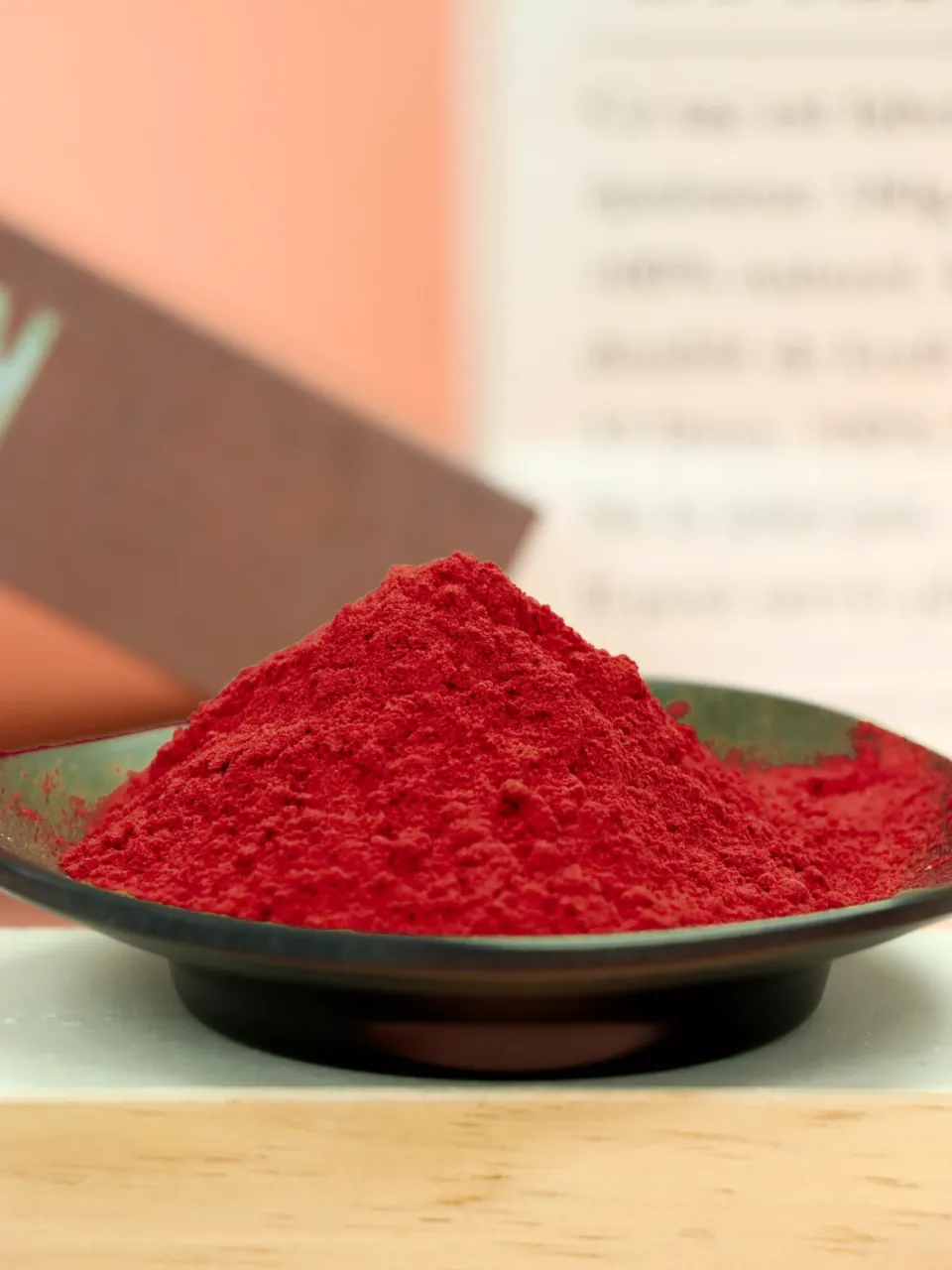
| Appearance | Reddish-brown to dark red crystalline powder |
| Solubility | Disodium salt is water-soluble; the free acid is only sparingly soluble in water. |
| Typical applications | Capsules, tablets, softgels, low-dose powder blends and stick packs for B2B nutraceutical manufacturing |
| Documentation | Download public specification sheet Public sheet prepared from the current product-page specification block; not a batch-specific Certificate of Analysis. Lot-specific COA and supporting records are available for qualified buyer review when appropriate. |
| Quality system | ISO 22000:2018, FSSC 22000, HACCP and GMP (certificates provided on request) |
| Supplier | Nutrition BioTech, 1601 W. Mission Blvd, Suite 103 (DL#29), Pomona, CA 91766, United States |
PQQ (RejuveSynergy™)
PQQ for mitochondrial, energy and healthy-aging supplement formulas.
Why brands ask for it
RejuveSynergy™ PQQ is positioned for mitochondrial support, energy and brain-health formulas. It fits premium low-dose products and pairs naturally with CoQ10, NAD boosters, alpha-lipoic acid and other mitochondrial support ingredients.
Finished-product fit
Energy, mitochondrial biogenesis story, brain health, CoQ10/NAD stack. The strongest conversations start with format, serving size, documentation, and how the material behaves in the intended formula.
What makes the sample useful
- Familiar mitochondrial ingredient
- Strong pairing with CoQ10 and NAD
- Low-dose premium active
Before the sample ships
- Confirm form.
- Confirm active marker, assay method, and specification range.
- Review serving-size logic and label-space fit.
- Confirm it stable.
- Confirm pairing with CoQ10/NAD.
File Package
Ask for the material files that match your market, dosage form, and internal review process.
Available documents may include: COA / Specification / Allergen Statement / GMO Statement / Vegan Statement / Heavy Metals / Microbial Limits / Manufacturing Flow Chart / Residual Solvent / Country of Origin / Composition Statement.
Regulatory & Facility Support
Regulatory review notes for the target market can be provided. Nutrition BioTech does not hold and does not claim any GRAS notification or NDI notification for this material.
Facility and quality system support follows the same certificate set named in the specification table: ISO 22000:2018, FSSC 22000, HACCP and GMP. The holding entity for each certificate is named on the certificate and confirmed under buyer review.
Specification FAQ
What is the CAS number for PQQ?
The CAS number for PQQ is 122628-50-6 (disodium salt, the commercial ingredient form) · 72909-34-3 (PQQ free acid). The molecular formula is C14H4N2Na2O8 (disodium salt) · C14H6N2O8 (free acid) and the molecular weight is 374.17 g/mol (disodium salt) · 330.20 g/mol (free acid). Machine-readable identifiers: CAS 122628-50-6 — InChIKey UFVBOGYDCJNLPM-UHFFFAOYSA-L · PubChem CID 3078772CAS 72909-34-3 — InChIKey MMXZSJMASHPLLR-UHFFFAOYSA-N · PubChem CID 1024.
What purity is PQQ supplied at, and by which method?
99% minimum by HPLC. The assay basis (as PQQ disodium salt or as PQQ equivalent) is stated on the Certificate of Analysis for each lot.
Is PQQ soluble in water?
Disodium salt is water-soluble; the free acid is only sparingly soluble in water.
Published research context
Pyrroloquinoline quinone has a long peer-reviewed literature. The studies below are provided as technical context for formulators evaluating this raw material. These entries summarise what the cited publications report. They are not claims about Nutrition BioTech material, and no health, therapeutic or cosmetic outcome is claimed or implied for any finished product. Buyers are responsible for the claims they make on their own labels and for confirming what is permitted in their market.
- Crystal form, hydration state and colour of the disodium saltPrepared a crystal of PQQ disodium trihydrate from ethanol and water and solved its structure, reporting that the sodium atom interacts with the oxygen atoms of two carboxylic acid groups and of two quinone groups. The colour and near-infrared spectrum of the prepared crystal changed with the water content of the dried samples, and the water content was restored on placing the samples in a humid environment. X-ray diffraction and X-ray diffraction differential scanning calorimetry showed that the phase of the trihydrate changed when crystallisation water was removed, that the dried crystal gave two crystalline forms, and that these returned to the original trihydrate at 20 percent relative humidity. The trihydrate was reported to be stable under normal conditions.Ikemoto K, Sakamoto H, Nakano M. Chem Cent J. 2012;6(1):57. PMID 22713213. DOI 10.1186/1752-153X-6-57. source
- Redox behaviour in the presence of ascorbic acidFollowed the reaction of PQQ disodium with vitamin C by UV-Vis spectrophotometry in phosphate-buffered solution at pH 7.4 and 25 degrees Celsius under a nitrogen atmosphere. The authors reported that one molecule of PQQ was reduced by two molecules of vitamin C to give one molecule of the quinol PQQH2, and that the PQQH2 produced was recycled to PQQ by air oxidation.Mukai K, Ouchi A, Nagaoka S, Nakano M. Biosci Biotechnol Biochem. 2016;80(1):178-187. PMID 26264520. DOI 10.1080/09168451.2015.1072462. source
- Validated UPLC-MS/MS ion transitions and working rangeDeveloped and validated a UPLC-MS/MS method for PQQ in rat plasma, operating multiple reaction monitoring in negative electrospray ionisation with the ion transition m/z 328.99 to 197.05 for PQQ and m/z 280.04 to 195.04 for the internal standard. Calibration curves were reported as linear up to 10,000 ng/mL with a lower limit of quantitation of 10 ng/mL, inter-run and intra-run precision of 1.79 percent to 10.73 percent, and accuracy of -7.73 percent to 7.30 percent.Sun Q, Hong Y, Yang Z, He P. Molecules. 2022;27(22):7947. PMID 36432048. DOI 10.3390/molecules27227947. source