
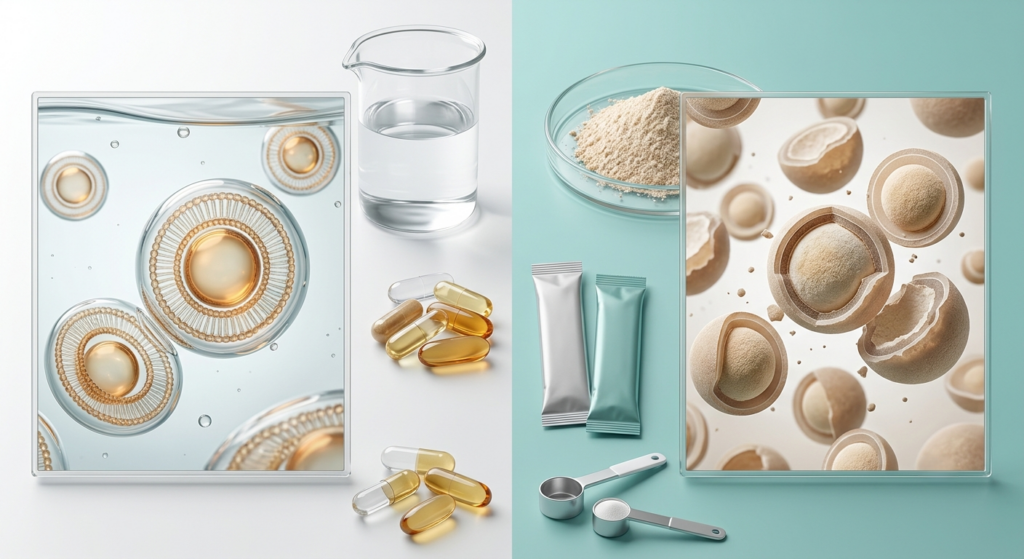
Liposomal supplement ingredients are getting more attention from supplement brands because consumers increasingly associate advanced delivery systems with premium products. At the same time, formulators are also revisiting microencapsulation, micelle systems and format-ready powders as they develop gummies, stick packs, capsules and functional liquids.
For B2B supplement brands, the key question is not whether liposomal delivery is always better than microencapsulation. The better question is: which delivery system fits the active ingredient, target dosage form, stability requirements, taste profile, documentation needs and claim-safe positioning?
NAD, berberine, PQQ and Urolithin A all have different formulation challenges. A delivery system that works for a liposomal NAD liquid may not be the best solution for a berberine stick pack or a PQQ capsule. Choosing the right system requires a practical review of ingredient properties and finished product goals.
Naturalbestbio’s How To Evaluate Nutraceutical Ingredients For Gummies, Stick Packs, Powders, And Liposomal Liquids provides a useful framework for brands comparing delivery systems across multiple formats.
Why Delivery Systems Matter for Sensitive Nutraceutical Actives
Many functional ingredients are difficult to formulate because they bring issues such as poor solubility, bitter taste, oxidation risk, moisture sensitivity, heat sensitivity, strong color or dose-load pressure.
A nutraceutical delivery system may help brands address one or more of these problems:
- Taste masking
- Powder flowability
- Moisture protection
- Improved dispersibility
- Better format compatibility
- Liquid compatibility
- Stability management
- More premium product positioning
However, delivery technology should not be used as a shortcut for exaggerated claims. A liposomal, micelle or microencapsulated system does not automatically prove stronger clinical outcomes. Brands still need active content data, stability information, format testing and appropriate claim language.
The real value of delivery technology is formulation fit. It helps product teams decide whether an ingredient can work in a capsule, gummy, stick pack, powder, softgel or liquid format.
Naturalbestbio’s Format-Ready Nutraceutical Proof Pack is aligned with this practical approach: helping brands evaluate ingredients for the products they actually want to launch.
Liposomal Supplement Ingredients: Best for Liquids, Softgels and Premium Delivery Stories
Liposomal supplement ingredients are often used when brands want an advanced delivery story. Liposomal systems may be relevant for oral liquids, softgels, shots or premium liquid formulations.
For B2B teams, the main appeal of a liposomal format is not only marketing. It may help support a liquid-based delivery concept when the active, carrier system and packaging are properly validated.
Key B2B checkpoints include:
- Particle size
- Active content
- Lipid system
- Encapsulation efficiency, if applicable
- pH compatibility
- Preservative system
- Sedimentation
- Shelf-life data
- Packaging compatibility
- Storage requirements
These checks are especially important for sensitive actives. A liposomal product can look attractive on a concept sheet, but if the active degrades, separates or becomes difficult to dose consistently, the product may not be commercially viable.
Brands should also be cautious with claim language. “Liposomal” can support a delivery technology story, but it should not be used to imply guaranteed higher absorption or superior outcomes unless fully substantiated and legally reviewed.
Microencapsulation: Better for Powders, Gummies, Stick Packs and Taste Masking
Microencapsulation is often more suitable when the finished product is a powder, gummy, stick pack or capsule. It can help protect sensitive ingredients, mask unpleasant taste, improve handling or support controlled release positioning when supported by supplier data.
For supplement brands, microencapsulation can be useful when an active is:
- Bitter
- Strongly colored
- Sensitive to moisture
- Sensitive to heat
- Difficult to blend
- Difficult to use in gummies
- Challenging in powder drink formats
B2B buyers should evaluate:
- Wall material
- Active load
- Encapsulation rate
- Release behavior, if claimed
- Flowability
- Mouthfeel
- Heat stability
- Moisture resistance
- Taste masking performance
- COA and specification documents
Naturalbestbio’s Microencapsulation vs. Liposomal Delivery provides additional context for formulators comparing delivery technologies for sensitive nutraceutical actives.
Liposomal vs Microencapsulation: A B2B Comparison
Liposomal delivery and microencapsulation are both useful, but they solve different formulation problems.
| Factor | Liposomal Delivery | Microencapsulation |
|---|---|---|
| Best formats | Liquids, softgels, shots | Powders, gummies, stick packs, capsules |
| Key value | Premium delivery story, liquid compatibility | Taste masking, powder stability, format flexibility |
| Main risk | Stability, pH, packaging, cost | Wall material, release behavior, mouthfeel, active load |
| Best actives | NAD and some liquid-compatible actives | Berberine, PQQ, Urolithin A and sensitive powders |
| Buyer checks | Particle size, active content, shelf life | Encapsulation rate, flowability, stability, release behavior |
The right choice depends on the finished product. If a brand is building a liquid NAD shot, a liposomal system may be worth evaluating. If a brand is building a berberine stick pack or gummy, microencapsulation or micelle-based powder technology may be more practical.
NAD and Liposomal NAD: When Delivery Technology Supports a Premium Formula
NAD, NMN and NADH ingredients can support several product concepts: capsules, powders, stick packs, liquids and liposomal formats. The best choice depends on stability, consumer education and desired product positioning.
Liposomal NAD can support a premium delivery story, especially for brands developing liquid or advanced delivery formats. However, brands need to review the technical data carefully.
Key questions include:
- Is the active content clearly documented?
- What is the stability profile?
- How is the lipid system characterized?
- Does the formula separate over time?
- What packaging is required?
- Are delivery claims substantiated?
- Is the final claim language compliant?
Naturalbestbio’s NMN, NAD+, NADH & Liposomal NAD Ingredients page is a relevant internal resource for brands evaluating NAD booster ingredients across multiple formats.
Brands should avoid claims such as “reverses aging,” “extends lifespan” or “guarantees NAD increase” unless claims are fully substantiated and legally reviewed. A safer approach is to position NAD ingredients around cellular energy metabolism, healthy aging routines and NAD booster product concepts.
Berberine: Why Solubility, Taste and Dose Load Shape the Delivery Choice
Berberine is a strong example of why delivery system selection matters. It has high consumer recognition in metabolic wellness, but it also presents formulation challenges.
Common issues include:
- Bitter taste
- Strong color
- High dose load
- Limited solubility
- Powder dispersibility issues
- Difficulty in gummies or functional drinks
For capsules, standard berberine may be practical because the format masks taste and supports defined serving sizes. For powders, stick packs or functional beverages, taste and solubility become much more important.
Naturalbestbio’s Berberine Pro-Micelle Fiber 50 is an example of a berberine platform designed for improved-solubility and dry powder metabolic wellness formats.
This type of format-ready approach can help brands develop more modern berberine products, but the positioning should remain careful. Brands can discuss solubility, powder compatibility and formulation review. They should not claim guaranteed weight loss, blood sugar control or drug-like performance.
PQQ: Stability and Mitochondrial Positioning for Energy Formulas
PQQ is often used in mitochondrial, energy and healthy aging supplement concepts. For B2B brands, the formulation questions are usually related to dose precision, powder compatibility, stability and ingredient documentation.
PQQ may be used in capsules, tablets, powder blends or mitochondrial wellness stacks. Depending on the final format, brands may need to evaluate moisture exposure, light exposure, flowability and compatibility with other actives.
Naturalbestbio’s PQQ Ingredient page can support brands developing mitochondrial wellness and energy-support formulas.
Microencapsulation may be worth evaluating for sensitive powder systems, but the supplier must provide meaningful data. Brands should not assume that microencapsulation automatically improves every formulation. The wall material, active loading, release behavior and stability performance all need to match the final product.
Urolithin A: Powder, Capsules and Longevity Product Fit
Urolithin A is commonly discussed in relation to mitophagy, cellular energy and longevity supplement positioning. For B2B brands, the practical issues include purity, particle size, capsule load, powder blending, stability and COA documentation.
A Urolithin A powder may fit capsule or powder formats depending on the formulation goal. If a brand wants to develop a functional drink or stick pack, dispersibility and mouthfeel become more important. If the target format is a capsule, flowability and capsule loading become more important.
Naturalbestbio’s Pomegranate-Derived Cellular Energy Metabolite is relevant for brands evaluating Urolithin A-style longevity and cellular energy concepts.
Delivery technology should support the finished product format. It should not be used to make aggressive anti-aging or disease-prevention claims.
How to Choose the Right Delivery System for a Finished Product Format
A delivery system should be selected after the brand defines the finished product format.
For capsules, brands should prioritize:
- Flowability
- Active loading
- Stability
- Compatibility with excipients
- Capsule size
- COA and assay data
For gummies, brands should evaluate:
- Heat stability
- Taste masking
- Water activity
- Active loading
- Texture over shelf life
- Interaction with acids and sweeteners
For stick packs and powders, brands should evaluate:
- Solubility
- Dispersibility
- Mouthfeel
- Moisture protection
- Powder flow
- Caking risk
- Flavor compatibility
For liquids, brands should evaluate:
- pH
- Microbial control
- Sedimentation
- Packaging compatibility
- Preservative system
- Active content over shelf life
For liposomal liquids, brands should add:
- Particle size
- Lipid system
- Encapsulation efficiency, if claimed
- Shelf-life data
- Delivery claim substantiation
This format-first approach prevents brands from choosing a delivery system only because it sounds premium.
What Brands Should Ask Suppliers Before Choosing Liposomal or Microencapsulated Ingredients
Before sourcing liposomal supplement ingredients or microencapsulated nutraceutical ingredients, brands should ask suppliers for technical documentation.
A practical supplier checklist includes:
- COA and assay method
- Active content
- Encapsulation efficiency, if applicable
- Particle size
- Wall material or lipid system
- Stability data
- Solubility or dispersibility data
- Taste profile
- Release behavior, if claimed
- Format compatibility
- Heavy metals
- Microbiology
- MOQ and lead time
- Sample availability
- Technical documentation
- Regulatory support
For research background, product teams can review PubMed literature on liposomal dietary supplement and microencapsulation nutraceuticals. These sources can help teams understand the technology landscape, but final marketing claims should still be reviewed carefully.
Claim-Safe Positioning for Delivery Technology
Delivery technology is attractive in marketing, but brands should avoid overclaiming.
Suitable language may include:
- Designed for format-ready supplement development
- Supports improved formulation compatibility
- Supports taste masking and stability goals
- Built for powder, gummy, capsule or liquid formats
- Delivery-system approach for sensitive nutraceutical actives
Avoid language such as:
- Guaranteed higher absorption
- Clinically superior bioavailability, unless substantiated
- Works better than standard supplements
- Treats disease
- Reverses aging
- Causes weight loss
- Controls blood sugar
The FDA’s guidance on Structure/Function Claims and Label Claims for Food & Dietary Supplements can help brands keep delivery technology claims within appropriate boundaries.
Conclusion
Liposomal supplement ingredients and microencapsulation both have value, but neither is a universal answer. Liposomal systems may fit liquids, softgels, shots and premium delivery concepts. Microencapsulation may be more practical for powders, gummies, stick packs, capsules, taste masking and stability management.
For NAD, berberine, PQQ and Urolithin A, the right delivery system depends on the active ingredient, finished product format, stability requirements, taste profile, supplier documentation and claim-safe positioning.
Brands should choose delivery technology as part of a formulation strategy, not as a marketing shortcut. To evaluate format-ready nutraceutical ingredients for your next product, explore Naturalbestbio’s How To Evaluate Nutraceutical Ingredients For Gummies, Stick Packs, Powders, And Liposomal Liquids, Format-Ready Nutraceutical Proof Pack and NMN, NAD+, NADH & Liposomal NAD Ingredients. wall material or lipid system, stability, taste, release behavior, format compatibility, MOQ, lead time and regulatory support.