
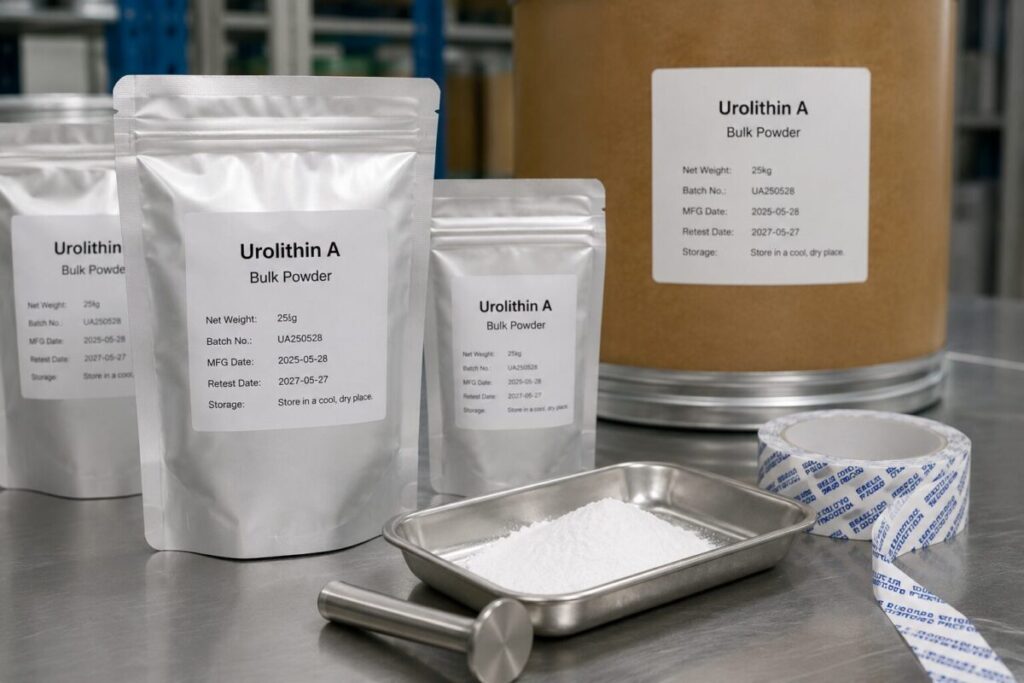
China Urolithin A quality should be verified with documents, samples and a repeatable supplier-review process—not inferred from a low quotation or a country label. For supplement brands, contract manufacturers, distributors and ingredient buyers, the useful question is whether the offered powder can be identified, tested, approved and supplied consistently for the intended market.
This guide is written for buyers comparing China-based Urolithin A powder suppliers. It explains how to review identity, assay, HPLC evidence, batch traceability, contaminants, production-route information, packaging and export documents before a bulk order. It also uses Nutrition BioTech’s current public Urolithin A specification as a concrete reference point: a pomegranate-derived metabolite at 98% minimum by HPLC, CAS 1143-70-0, with sample and document support available for buyer review. The public specification is a reference for evaluation, not a substitute for the lot-specific documents of any supplier.
What “China Urolithin A Quality” Should Mean to a Buyer
The phrase “China Urolithin A supplier” can describe a manufacturer, a distributor, an export company or a sourcing intermediary. Country of origin alone does not establish quality. A buyer needs to understand the supplier’s role, the material’s actual production route and who controls the batch record.
Before requesting a final quotation, ask:
- Is the company manufacturing the material, holding stock or arranging supply through another producer?
- Which legal entity will appear on the quotation, invoice, COA and shipping documents?
- Is the quoted material Urolithin A, a related metabolite or a finished-product premix?
- Is the assay specification tied to a real batch or only an indicative product sheet?
- Can the supplier provide a representative sample and matching documents?
- What quality, export and change-notification support is available after the first order?
This is why the Urolithin A raw material supplier checklist should be read alongside a country-specific comparison. The main sourcing page covers supplier identity and purchase controls; this page focuses on the evidence a buyer should request when comparing China-based offers.
Use a Written Specification Before Comparing Price
A written specification gives the buyer a common basis for comparing suppliers. Without one, a quotation that says “98% Urolithin A” may hide differences in assay basis, identity method, production route, physical form, contaminant testing, packaging or documentation.
At minimum, write down the following requirements before sending an RFQ:
| Requirement | Why it matters |
|---|---|
| Ingredient name and form | Prevents comparison of different metabolites, salts or premixes |
| CAS number or identity basis | Helps QA connect the material to a defined chemical identity |
| Assay target and method | Defines what “98%” means and how it must be measured |
| Production route | Supports process, solvent and regulatory review |
| Appearance and physical form | Helps match the approved sample to the commercial material |
| Moisture and particle requirements | Influences handling, blending and storage |
| Contaminant panel | Sets expectations for heavy metals, microbiology and solvents |
| Packaging and storage | Determines whether the material can be protected through shipment and warehousing |
| Sample, MOQ and lead time | Connects technical approval to a realistic launch plan |
Nutrition BioTech’s public Urolithin A ingredient specification identifies the material as a pomegranate-derived metabolite, 98% minimum by HPLC and CAS 1143-70-0. It also states that current production is by fermentation and that the production route for each lot is stated on the COA. Buyers should use those fields as a model for the questions they ask any supplier; they should not assume that another supplier offers the same route or grade.
Urolithin A Identity: Confirm the Material Before Testing Purity
Identity review comes before purity comparison. If two suppliers use the same English product name but provide different chemical forms or documentation, their assay numbers are not directly comparable.
Ask each supplier to provide:
- Full ingredient name and any trade or grade name.
- CAS number and identity basis.
- Molecular formula or other controlled identity information where relevant.
- Production or source description.
- Sample label that matches the quotation and COA.
- Identity method or supporting record used for batch release.
For neutral chemical background, see the PubChem Urolithin A record. PubChem helps orient a technical team to the compound identity; it does not authenticate a supplier’s batch. Commercial approval should be based on the supplier’s controlled specification, lot documents and, where appropriate, the buyer’s own incoming-material testing.
If the supplier changes the identity description between quotation, sample, COA and invoice, stop the review until the discrepancy is explained. A naming mismatch may be a simple translation issue, but it can also indicate that the buyer is comparing different materials.
HPLC Testing: What to Ask for Beyond “98%”
HPLC or UHPLC data becomes useful when it is tied to a defined method and a specific lot. A percentage alone does not tell the buyer what reference standard, system suitability, integration rules or impurity separation were used.
For a China Urolithin A supplier, ask:
- Which HPLC or UHPLC method is used for the assay?
- Is the method internal, compendial, third-party or based on published analytical work?
- What reference standard is used, and is the assay reported on a stated basis?
- Does the method separate Urolithin A from related compounds and process impurities?
- Can the supplier provide a representative chromatogram or controlled method summary under buyer review?
- Is the same method used for the sample and future commercial lots?
An open-access UHPLC method for Urolithin A in health products can help a technical team understand why method details and chromatographic separation matter. It is research background, not proof of any supplier’s quality. A buyer may also use the existing Urolithin A HPLC and COA quality page as the internal quality-review hub once this article replaces the shorter version.
What a Urolithin A COA Should Contain
A certificate of analysis should allow the buyer to match the document to the material received. A generic example COA can show the supplier’s intended format, but it cannot approve a production lot.
Review these fields:
| COA field | Buyer check |
|---|---|
| Product and grade | Matches the RFQ, specification and sample label |
| Batch or lot number | Matches the container and shipping record |
| Manufacturing date | Fits current inventory and the proposed shelf-life window |
| Retest or expiry date | Leaves enough time for pilot and commercial use |
| Assay and method | Shows the actual result, acceptance range and named method |
| Identity result | Connects the lot to the declared Urolithin A material |
| Moisture and appearance | Matches the agreed physical specification |
| Heavy metals and microbiology | Includes results and limits required by the project |
| Residual solvents | Addresses the production route and target-market requirements |
| Quality release | Shows approval or release under the supplier’s quality process |
Match the COA to the supplier’s specification line by line. Check units, decimal places, assay basis and method names—not only the pass/fail conclusion. If the COA says “meets standard” without a result or limit, request the controlled result before final approval.
Nutrition BioTech’s supplier COA review guide provides a general document-checking framework. Buyers should adapt it to their own quality agreement, destination market and finished-product risk assessment.
Contaminant and Process-Related Review
China Urolithin A quality reviews should include a risk-based contaminant panel. The correct scope depends on the production route, raw materials, solvents, handling environment and market requirements. Do not use a generic checklist to imply that every supplier must provide an identical panel, but do not accept an undefined “tested” statement either.
Ask the supplier to clarify:
- Which heavy-metal limits apply and which method supports the result.
- Which microbiological tests are performed and how limits are defined.
- Whether residual-solvent testing is applicable to the stated route.
- Whether the production route creates specific related-substance questions.
- Whether allergen, GMO, vegan, country-of-origin or composition statements are available when needed.
- Whether third-party reports can be reviewed for a first order or high-value project.
For U.S. supplement manufacturing context, review 21 CFR Part 111 and FDA’s dietary supplement cGMP compliance guide. These sources explain quality-system expectations; they do not certify a China supplier or replace the buyer’s own qualification program.
Sample Approval: The Most Useful Reality Check
A sample connects the document review to the physical ingredient. Request a sample before a commercial order whenever the project value, formulation risk or supplier uncertainty justifies it.
Use this sequence:
- Request the written specification and a recent COA.
- Ask whether the sample is from current inventory and whether it represents the commercial grade.
- Record the sample label, lot number, date received and packaging condition.
- Compare the sample label with the COA, quotation and specification.
- Evaluate appearance, handling, particle behaviour and the intended dosage-form fit.
- Retain an archive portion for comparison with the first commercial lot.
- Consider independent testing when required by the buyer’s quality system.
For capsules and tablets, discuss bulk density, flow and blend uniformity with the contract manufacturer. For powders and stick packs, review dispersion, sensory impact and packaging protection. A sample that looks correct is not automatically approved; it must also pass the buyer’s written quality and formulation checks.
Factory, Trader or Export Supplier?
A China-based supplier does not have to be the original manufacturer to be useful. A distributor may provide better export support, while a factory may provide deeper process information. The buyer’s task is to document the role and assign responsibilities clearly.
Ask:
- Which entity owns or controls the manufacturing batch?
- Who issues the COA and who answers technical deviations?
- Can the supplier arrange a factory audit or qualified third-party review if needed?
- What happens if the manufacturing site, method or specification changes?
- Which entity appears on export documents and commercial invoices?
- Can the supplier support repeat orders with the same grade and document package?
For a broader comparison, see the Urolithin A supplier page, the high-purity Urolithin A manufacturer guide and the Urolithin A wholesale sourcing guide. These pages cover adjacent supplier, purity and procurement questions; they should not be treated as proof that every listed supplier has the same manufacturing role.
Export Documents, Packaging and Logistics
Quality can be lost operationally if the shipment, packaging and warehouse route are not controlled. Before placing a bulk order, confirm:
- Inner and outer packaging, net weight and tamper evidence.
- Lot labels on each package and on the shipping documents.
- Storage temperature, moisture and light-protection requirements.
- Retest period and any transport restrictions.
- Commercial invoice, packing list, certificate of origin and other importer-required files.
- Responsibility for customs, insurance, inspection and damaged packages.
- Change-notification and complaint-handling contacts after delivery.
Do not assume that a supplier’s export experience covers your destination market. The importer, contract manufacturer and regulatory adviser may require additional documents or a different format. Put those requirements into the RFQ and quality agreement before the shipment is released.
How to Compare Quotes Fairly
Prepare a side-by-side comparison rather than ranking suppliers on price alone. Include the quoted assay and method, batch size, sample source, COA scope, contaminant panel, packaging, MOQ, lead time, export documents and payment terms. Mark each item as confirmed, conditional or missing.
A lower price may reflect a different assay basis, larger MOQ, less testing, weaker packaging or a distributor’s limited document access. Conversely, a higher price is not proof of superior quality. The defensible decision is the one supported by a clear specification, traceable sample, adequate testing and workable commercial controls.
Nutrition BioTech’s Public Urolithin A Reference Point
Nutrition BioTech’s current Urolithin A ingredient page publicly describes:
- Urolithin A as a pomegranate-derived metabolite.
- CAS 1143-70-0.
- 98% minimum assay by HPLC.
- Fermentation as the current production route, with route information stated per lot on the COA.
- COA, specification and sample support for buyer review.
- An ISO 22000 and FSSC 22000 certified quality-system context stated on the product page.
These are public product-page statements, not a substitute for the current lot file. Buyers should request the exact specification, COA, sample status and supporting quality documents for their project. For facility information, see quality certifications; for a project-specific request, use Contact Nutrition BioTech.
Claim and Regulatory Boundaries
Urolithin A is discussed in research and healthy-aging product development, but sourcing evidence is not the same as finished-product claim substantiation. Keep this page focused on identity, assay, quality documents, formulation fit and supplier controls.
For U.S. projects, review FDA’s dietary supplement labeling guide. Market-specific rules may differ for ingredients, dosage forms and claims. Avoid saying that Urolithin A treats, cures, prevents or reverses a disease or that a supplier guarantees a clinical outcome or regulatory approval.
Red Flags in China Urolithin A Supplier Reviews
Pause the order if a supplier:
- Cannot identify the legal entity responsible for the batch.
- Uses “98%” without naming the assay method or basis.
- Sends a COA without a lot number, date or release information.
- Refuses to provide a representative sample.
- Changes the material name between quotation, sample and COA.
- Cannot explain production route, solvent relevance or contaminant scope.
- Provides no packaging, storage or export-document plan.
- Pressures the buyer to pay before quality review.
- Uses disease or drug-comparison claims in place of technical evidence.
FAQ
How do I verify China Urolithin A quality before a bulk order?
Start with the supplier’s legal identity, written specification, lot-specific COA and representative sample. Confirm the assay method, identity, contaminant scope, packaging and commercial terms before approval.
What does 98% Urolithin A by HPLC mean?
It is a stated assay specification supported by an HPLC method. Buyers should request the acceptance range, actual lot result, assay basis and method details; the percentage alone is not complete evidence.
What CAS number is listed for the Nutrition BioTech Urolithin A ingredient?
The current public product page lists CAS 1143-70-0 for its pomegranate-derived metabolite Urolithin A ingredient. Request the current lot-specific COA and specification before commercial approval.
Should I request a Urolithin A chromatogram?
For a first order, high-value project or unusual price difference, requesting a representative chromatogram or controlled method summary can help the technical team assess the assay evidence. It does not replace independent testing when that is required.
Does a China supplier’s certificate guarantee U.S. regulatory approval?
No. Regulatory status depends on the destination market, finished-product format, dosage, label and claims. Supplier documents support the review but do not create universal approval.
What documents should a China Urolithin A supplier provide?
Typical requests include a specification sheet, lot-specific COA, SDS, identity and contaminant results, storage and packaging information, country-of-origin or manufacturing statements, and export documents required by the importer.
Conclusion: Approve Evidence, Not a Country Label
China Urolithin A quality is best assessed through a consistent evidence path: define the material, verify identity, review HPLC and COA data, approve a traceable sample, assess contaminants and formulation fit, then confirm packaging, export documents and repeat-order controls. Nutrition BioTech’s public 98% HPLC Urolithin A specification provides a concrete reference for the type of information a buyer should request, while the final decision must always rely on current lot-specific documentation and the buyer’s own quality procedures.
For current product specifications, sample availability and supporting documents, review the Urolithin A ingredient page and contact Nutrition BioTech.
To request a Urolithin A file package, contact Nutrition BioTech through the contact page.
Related ingredient pages
For buyer evaluation, compare this guide with the closest Nutrition BioTech ingredient pages and sourcing route.