

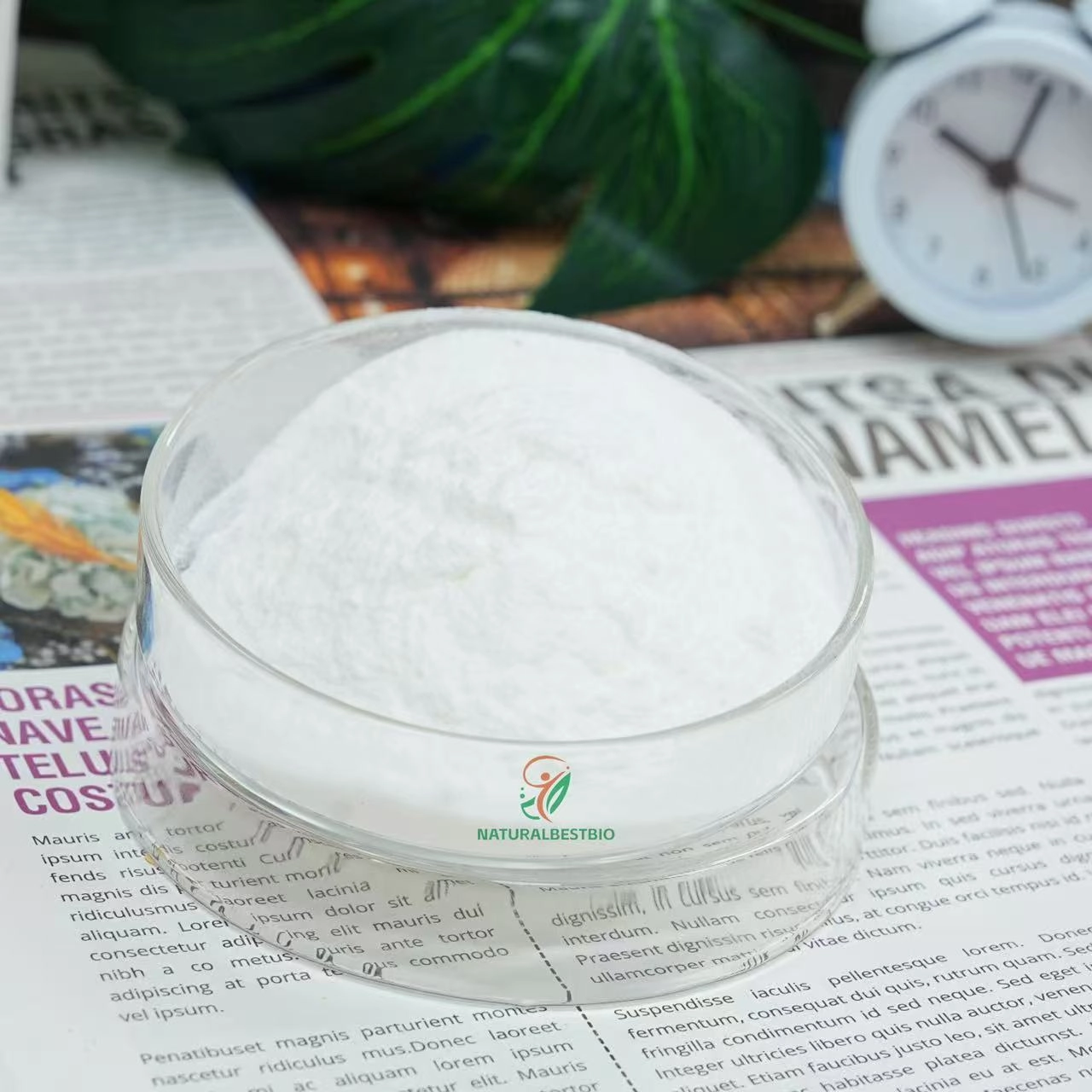
Trigonelline 98% (TriVitaTone™) supplier specification
Nutrition BioTech is a bulk trigonelline ingredient supplier and manufacturer, supplying trigonelline as TriVitaTone™ in two grades — the free betaine (CAS 535-83-1) and trigonelline hydrochloride (CAS 6138-41-6) — each at 98% minimum by HPLC, produced by chemical synthesis from nicotinic acid, for B2B nutraceutical formulation.
The salt form is the first specification decision on this material, because a 98% assay on the hydrochloride and a 98% assay on the free betaine do not deliver the same amount of trigonelline per gram. The form, the assay and the assay basis are stated per lot on the Certificate of Analysis.
| Ingredient name | Trigonelline 98% — TriVitaTone™. Two grades supplied: free betaine and hydrochloride. |
|---|---|
| Synonyms | Trigonelline; N-methylnicotinate; 1-methylpyridin-1-ium-3-carboxylate; N-methylnicotinic acid betaine; caffearine; coffearine |
| CAS number | 535-83-1 (free betaine); 6138-41-6 (trigonelline hydrochloride) |
| Machine-readable identifiers | CAS 535-83-1 — InChIKey WWNNZCOKKKDOPX-UHFFFAOYSA-N · PubChem CID 5570 CAS 6138-41-6 — InChIKey TZSYLWAXZMNUJB-UHFFFAOYSA-N · PubChem CID 134606 |
| Molecular formula | C7H7NO2 (free betaine); C7H7NO2 · HCl (hydrochloride) |
| Molecular weight | 137.14 g/mol (free betaine); 173.60 g/mol (hydrochloride) |
| Assay / purity | 98% minimum by HPLC for both grades, each reported together with its salt form and assay basis on the Certificate of Analysis for each lot. |
| Salt form and dosing basis | Both grades are supplied as separate specifications and the form is fixed per order. On a stoichiometric basis one gram of the hydrochloride corresponds to approximately 0.79 g of trigonelline base, so at the same 98% assay the two forms are not interchangeable at equal weight. Fix the form before label claims, overage and cost-in-use are calculated. |
| Source / production route | Produced by chemical synthesis from nicotinic acid by methylation. Trigonelline also occurs naturally in coffee (Coffea spp.) green beans and in fenugreek (Trigonella foenum-graecum) seed; where botanical-derived material is requested, the route and its documentation are specified per order. |
| Appearance | White to off-white crystalline powder |
| Solubility | Water-soluble. Moisture pickup should be controlled during handling and storage; water content is reported per lot on the Certificate of Analysis. |
| Typical applications | Capsules, tablets, sachets, stick packs and powder blends for B2B nutraceutical manufacturing; commonly formulated alongside NAD precursors and cellular-energy actives |
| Regulatory note | Ingredient status and labelling requirements for trigonelline differ by jurisdiction and can differ between synthetic and botanical-derived material. Buyers are responsible for confirming permitted status in their intended markets. |
| Documentation | Download public specification sheet Public sheet prepared from the current product-page specification block; not a batch-specific Certificate of Analysis. Lot-specific COA and supporting records are available for qualified buyer review when appropriate. |
| Quality system | ISO 22000:2018, FSSC 22000, HACCP and GMP (certificates provided on request) |
| Supplier | Nutrition BioTech, 1601 W. Mission Blvd, Suite 103 (DL#29), Pomona, CA 91766, United States |
Trigonelline (TriVitaTone™)
Trigonelline for next-generation cellular energy, NAD and muscle-aging support formulas.
Why brands ask for it
TriVitaTone™ Trigonelline is a 2026-priority ingredient for brands building cellular energy, muscle-aging and GLP-1 companion products. It connects naturally to NAD metabolism, cellular-energy and active-lifestyle support and healthy-aging positioning.
Finished-product fit
Energy metabolism, muscle aging, healthy aging, GLP-1 companion, coffee/fenugreek metabolite story. The strongest conversations start with format, serving size, documentation, and how the material behaves in the intended formula.
What makes the sample useful
- New longevity signal
- NAD and muscle-aging connection
- Strong fit for post-GLP-1 support products
Before the sample ships
- Confirm source, identity, and supporting documentation.
- Confirm active marker, assay method, and specification range.
- Review serving-size logic and label-space fit.
- Confirm human evidence.
- Confirm does it relate to NAD.
File Package
Ask for the material files that match your market, dosage form, and internal review process.
Available documents may include: COA / Specification / Allergen Statement / GMO Statement / Vegan Statement / Heavy Metals / Microbial Limits / Manufacturing Flow Chart / Residual Solvent / Country of Origin / Composition Statement.
Regulatory & Facility Support
Regulatory review notes for the target market can be provided. Nutrition BioTech does not hold and does not claim any GRAS notification or NDI notification for this material.
Facility and quality system support follows the same certificate set named in the specification table: ISO 22000:2018, FSSC 22000, HACCP and GMP. The holding entity for each certificate is named on the certificate and confirmed under buyer review.
Specification FAQ
What is the CAS number for Trigonelline?
The CAS number for Trigonelline is 535-83-1 (free betaine); 6138-41-6 (trigonelline hydrochloride). The molecular formula is C7H7NO2 (free betaine); C7H7NO2 · HCl (hydrochloride) and the molecular weight is 137.14 g/mol (free betaine); 173.60 g/mol (hydrochloride). Machine-readable identifiers: CAS 535-83-1 — InChIKey WWNNZCOKKKDOPX-UHFFFAOYSA-N · PubChem CID 5570CAS 6138-41-6 — InChIKey TZSYLWAXZMNUJB-UHFFFAOYSA-N · PubChem CID 134606.
What purity is Trigonelline supplied at, and by which method?
98% minimum by HPLC for both grades, each reported together with its salt form and assay basis on the Certificate of Analysis for each lot.
Is Trigonelline soluble in water?
Water-soluble. Moisture pickup should be controlled during handling and storage; water content is reported per lot on the Certificate of Analysis.
How is Trigonelline produced and where does it come from?
Produced by chemical synthesis from nicotinic acid by methylation. Trigonelline also occurs naturally in coffee (Coffea spp.) green beans and in fenugreek (Trigonella foenum-graecum) seed; where botanical-derived material is requested, the route and its documentation are specified per order.
Published research context
Trigonelline has a long peer-reviewed literature. The studies below are provided as technical context for formulators evaluating this raw material. These entries summarise what the cited publications report. They are not claims about Nutrition BioTech material, and no health, therapeutic or cosmetic outcome is claimed or implied for any finished product. Buyers are responsible for the claims they make on their own labels and for confirming what is permitted in their market.
- Isotope-dilution LC-MS/MS quantification and roasting behaviourDeveloped a stable isotope dilution LC-MS/MS assay for the quantitative determination of trigonelline, nicotinic acid and nicotinamide in foods, with coefficients of variation of 2.1%, 1.1% and 3.1% respectively in a coffee sample and recoveries of 98.5-104.5%, and reported that roasting drastically degrades trigonelline, with the nicotinic acid generated accounting for 4-6% of the initial trigonelline content.Lang R, Yagar EF, Eggers R, Hofmann T. J Agric Food Chem. 2008;56(23):11114-11121. PMID 19007232. DOI 10.1021/jf802838s. source
- Direct proton NMR determination without derivatizationProposed a quantitative ¹H NMR method for caffeine, formic acid, trigonelline and 5-(hydroxymethyl)furfural in soluble coffees, using the singlet signals each compound records in the 7.6-9.5 ppm region and an exactly weighed internal standard; for trigonelline the reported detection limit was 0.58 mg/g of solid product with a coefficient of variation of 2.4%, and no derivatization was needed.del Campo G, Berregi I, Caracena R, Zuriarrain J. Talanta. 2010;81(1-2):367-371. PMID 20188932. DOI 10.1016/j.talanta.2009.12.010. source
- Quantitative NMR across 292 roasted coffee samplesDeveloped a fit-for-purpose quantitative ¹H NMR methodology, studied on 292 roasted coffee samples analysed in triplicate, that quantified twelve constituents including trigonelline and nicotinic acid using a combination of traditional integration and spectral deconvolution, and used the resulting data to support classification of coffees and prediction of blend percentages.Burton IW, Martinez Farina CF, Ragupathy S, Arunachalam T, Newmaster S, Berrué F. J Agric Food Chem. 2020;68(49):14643-14651. PMID 33252222. DOI 10.1021/acs.jafc.0c06239. source
- Validated UPLC-MS/MS marker method for fenugreek standardizationReported a validated UPLC-MS/MS method using trigonelline as a standardization and quality-control marker for Trigonella foenum-graecum (fenugreek) seed material, with a linearity r² of 0.999, an ESI-positive fragmentation pattern of m/z 138 to 94.10, quantification performed on 10 mg samples from five different origins, and water giving the highest trigonelline yield among the extraction solvents tested.Aldholmi M, Ahmad R, Hago S, Alabduallah A. F1000Res. 2024;13:1350. PMID 39931315. DOI 10.12688/f1000research.157659.3. source