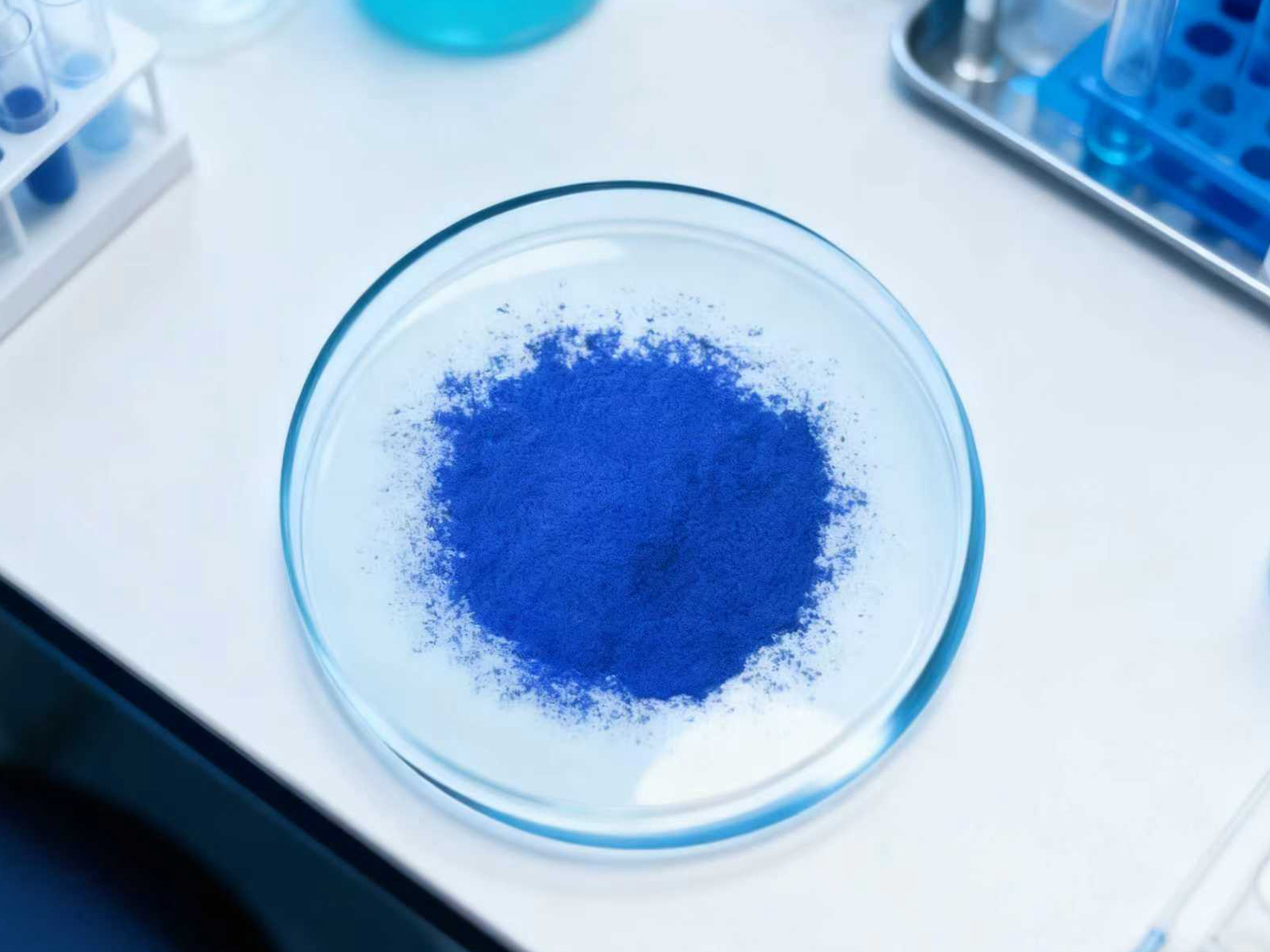
In today's skincare market that pursues both high efficiency and gentleness, an ingredient called Copper Peptide (GHK-Cu) has been gaining significant attention for its outstanding efficacy. It is not only a "powerhouse" in the skincare field but also a representative that balances safety and functionality. Today, let's take an in-depth look at this "star ingredient" in the skincare world.
I. Understanding Copper Peptide: From Its Essential Nature to the Origin of Its Name
Copper Peptide, also known as Copper Tripeptide, often appears as "Copper Tripeptide-1" in the ingredient lists of skincare products. It is a small-molecule protein, specifically a complex formed by a tripeptide (Tripeptide-1) composed of three amino acids—glycine, histidine, and lysine—and a copper ion.
Its unique "blue" color is not from artificially added pigments but from the copper ion it carries. The peacock blue hue makes it highly recognizable among numerous ingredients. More notably, Copper Peptide is not an artificially synthesized "outsider"; it is widely present in human plasma and body fluids. Moreover, copper ions, as essential elements for the normal operation of human tissues and organs, are of great significance for maintaining healthy skin. However, the content of Copper Peptide in the human body gradually decreases with age. Research data shows that Copper Peptide is involved in the interaction of nearly 4,000 genes in the human body, which lays a solid foundation for its wide range of skincare functions. It also plays an indispensable role in the process of skin health and repair.
II. The "Growth History" of Copper Peptide: From Discovery to Skincare Application
The discovery and research of Copper Peptide is a journey filled with scientific exploration.
In 1973, Dr. Loren Pickart, an American scientist, accidentally discovered a naturally occurring plasma peptide in serum while researching the question of "why the liver tissue of the elderly can still synthesize new proteins". Through in-depth research and analysis later, it was confirmed that this plasma peptide is formed by the combination of a copper ion and a tripeptide (Tripeptide-1) composed of glycine, histidine, and lysine. Due to its unique peacock blue color, it was officially named Copper Peptide.
In 1985, researchers further discovered that Copper Peptide has excellent wound repair capabilities. This discovery initially revealed its application potential in the field of skin care.
In 1999, Copper Peptide officially entered the skincare field. Up to now, it has a history of application for more than 20 years. After long-term market verification, its safety and effectiveness have been widely recognized.
III. Key Parameters: Concentration and Chemical Formula
(I) Scientific Concentration: Balancing Efficacy and Safety
One of the major advantages of Copper Peptide is its "high efficiency and gentleness". Its normal concentration range is between 0.04% and 0.2%, and within this range, it can fully exert its skincare effects. However, it should be noted that if the concentration is too high, it will not only fail to enhance the effect but may also cause cytotoxicity and damage the skin. This also reminds us that when choosing skincare products containing Copper Peptide, higher concentration is not necessarily better. Products that follow the scientific concentration ratio are more trustworthy.
(II) Clear Chemical Formula: Gaining Insight into the Essential Nature of the Ingredient
The molecular formula of Copper Peptide is C₁₄H₂₂N₆O₄.Cu. The clear chemical composition allows us to understand the essential nature of this substance more intuitively and also provides a basis for researchers to further study its mechanism of action.
IV. Core Effects of Copper Peptide: Protecting Skin Health in Multiple Dimensions
(I) Anti-Wrinkle and Anti-Aging: Awakening the Youthful Vitality of the Skin
Copper Peptide performs exceptionally well in anti-wrinkle and anti-aging. Without damaging or irritating the skin, it can enhance cell vitality, stimulate the synthesis of collagen and elastin, and at the same time restore the regenerative capacity of fibroblasts in the dermis. With long-term use, it can effectively increase skin density and firmness, slow down the skin aging process, enhance skin elasticity, and reduce the formation of fine lines and wrinkles.
This effect is not groundless; it is supported by a number of clinical studies. In a 1998 literature, researchers conducted a comparative experiment: 20 volunteers were selected, and creams containing vitamin C, retinoic acid, and Copper Peptide were applied to their thighs respectively. After one month of testing, it was found that collagen increased by 50% in the vitamin C group, 40% in the retinoic acid group, and as high as 70% in the Copper Peptide group. Its ability to promote collagen production is significantly better than the other two groups.

In addition, in 2012, Dr. Loren Pickart, the discoverer of Copper Peptide, published an article pointing out that as a signal peptide, Copper Peptide can release specific signals after entering the skin, induce the activation of fibroblasts, and further stimulate collagen production, which explains the mechanism of its anti-aging effect from a mechanistic perspective.
(II) Antioxidation: Building a "Protective Shield" for the Skin
Copper Peptide has significant antioxidant properties. It can effectively block the formation of reactive oxygen species (ROS) and scavenge free radicals and peroxides in the skin. In daily life, factors such as UV radiation and environmental pollution can cause the skin to produce a large number of free radicals, accelerating skin aging. Copper Peptide can protect skin cells from these external damages, building a solid "protective shield" for the skin and thus slowing down skin aging.
(III) Repair and Anti-Inflammation: A "Considerate Guardian" for Sensitive Skin
In terms of skin repair, Copper Peptide can promote the production of keratinocytes, increase skin thickness, and at the same time stimulate the production of intercellular substances, helping to restore the integrity of the damaged skin barrier. This effect is particularly important for sensitive or damaged skin, as it can enhance the skin's self-protection ability and improve the fragile state of the skin.
At the same time, Copper Peptide also has excellent anti-inflammatory effects. It can inhibit the synthesis of inflammatory factors, effectively reduce skin inflammatory reactions, and achieve the effects of calming and soothing the skin, further enhancing the skin's resistance. This allows people with sensitive skin to enjoy the skincare process with peace of mind.
(IV) Gene Regulation/Repair: Empowering the Skin from the Root
Another powerful aspect of Copper Peptide lies in its gene regulation and repair capabilities. It can regulate the expression of nearly 4,000 genes in the human body. This characteristic of acting at the genetic level gives it great potential in the fields of skin repair and anti-aging, enabling it to empower the skin from the root, help the skin maintain a healthy state, and improve the overall skin quality.
V. Suitable Skin Types: Gentle and Friendly, Benefiting Most People
One of the greatest advantages of Copper Peptide is its gentleness, with extremely low irritation, making it suitable for most people to use. Even people with relatively sensitive skin can easily use skincare products containing Copper Peptide without worrying about irritation or discomfort. Whether it is mature skin that needs anti-wrinkle and anti-aging care or sensitive skin that requires barrier repair, all can receive targeted skin care through Copper Peptide.
With its gentle properties, diverse effects, and solid scientific research support, Copper Peptide has become an outstanding high-quality ingredient in the skincare field. It is believed that with the continuous development of scientific research technology, it will exert more potential in the field of skin care and bring healthy and youthful skin to more people.
Important Reminder:All content in this article is for general reference only and is provided solely to offer information support for practitioners in the nutrition and health industry. Descriptions related to efficacy are supported by corresponding data, but they do not represent claims or guidance for consumers. Content related to health, medical care, and technological applications is for reference only. For medical matters, please consult professional medical institutions and follow medical advice. This article does not provide any medical recommendations.


