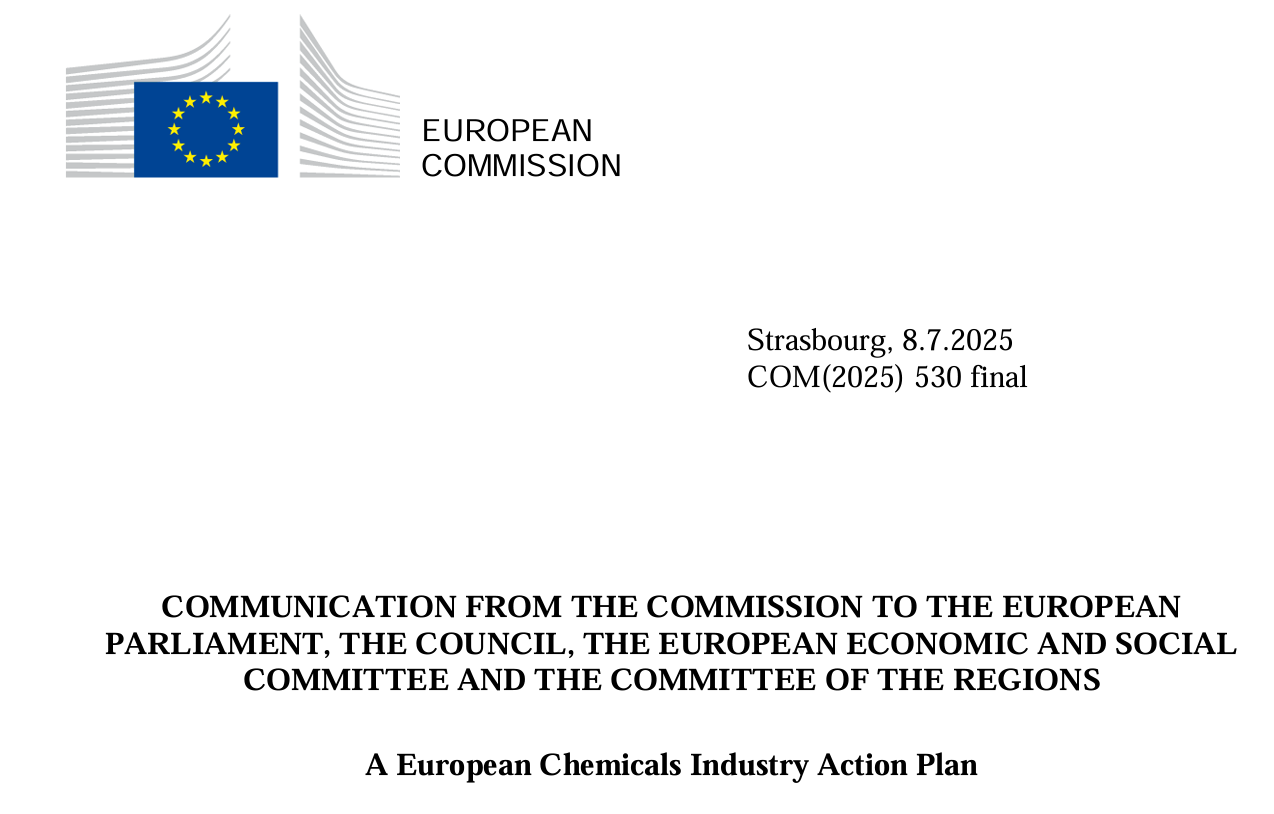
On July 8, 2025, Section 4.2 of the European Chemical Industry Action Plan (COM(2025) 530 final) released by the European Commission clearly stipulates that animal testing in chemical safety assessments will be phased out gradually starting from 2026, and new approaches (NAMs) such as organoids will be mandatorily adopted. This policy aligns with Towards a Future Without Animal Testing (COM(2024) 146 final) released in 2024, marking a historic transition in global scientific research from the "animal model" to the "human biological model".
According to estimates by the European Chemicals Agency (ECHA), the market size of chemical safety assessment in the EU alone reaches €21.7 billion, and organoid technology will account for 62% of this market share (Source: ECHA Market Forecast 2025). Combining the original policy text, international regulatory developments, and industrial cases, this article conducts an in-depth analysis of the systematic changes in the organoid industry from technical, commercial, and ethical dimensions.
I. Policy Core: Organoids Gain Statutory Regulatory Status to Build an Animal-Testing-Free System
1.1 First Establishment of Legal Alternative Status
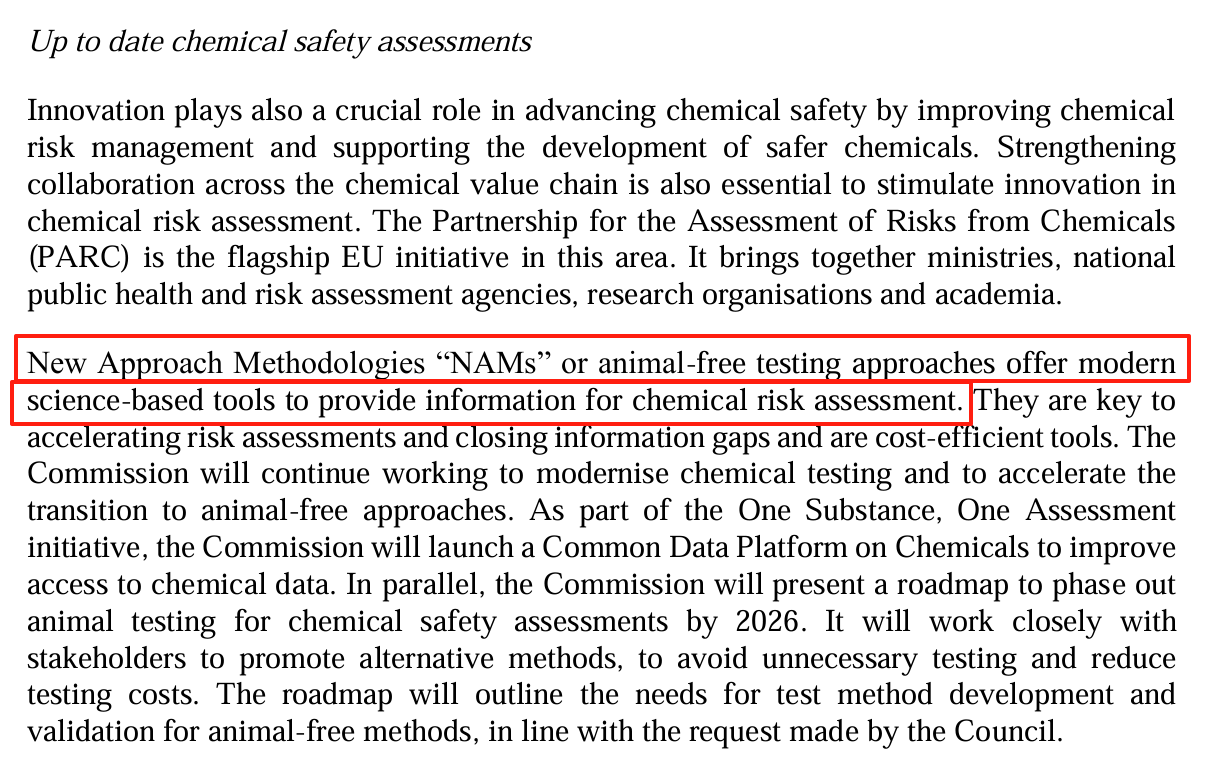
The "Innovation" clause in Section 4.2 of the European Chemical Industry Action Plan clearly requires: "The Commission will propose a roadmap for phasing out animal testing in chemical safety assessments by 2026, and New Approach Methodologies (NAMs) will serve as key tools to accelerate risk assessment."
This marks the first time that organoid technology has obtained equal legal status with animal testing under the EU regulatory framework. According to the interpretation of EUR-Lex, the EU's judicial database, this clause means that after 2026, organoid data can be independently used as compliance evidence in chemical registration dossiers, without the need for corroboration by animal testing (Source: EUR-Lex CASE LAW 2025/07/089).
Implementation Roadmap:
-
Q1 2025: Release a roadmap for phasing out animal testing, specifying the replacement timeline for 34 categories of chemicals including cosmetics and pesticides (Source: ECHA Roadmap Draft);
-
2026: Revise Annexes VII-X of the REACH Regulation, incorporating organoid-based acute toxicity testing into mandatory requirements (Source: REACH Amendment Proposal 2025);
-
2027: Establish the Common Data Platform on Chemicals to realize cross-enterprise sharing of organoid data (Source: EU Digital Strategy 2025).
The policy addresses the regulatory legitimacy of organoid technology through legislation. The Common Data Platform will break down technical barriers between enterprises and reduce compliance costs for small and medium-sized enterprises (SMEs). The upgrade of organoids from a scientific research tool to a regulatory tool lays the institutional foundation for the industrial boom.
1.2 Strategic Expansion to the Entire Scientific Research Field
As early as 2024, the EU's strategic document Towards a Future Without Animal Testing has outlined plans to replace 50% of animal testing for drug toxicity by 2030 (Source: COM(2024) 146 final, P.12), and to use lung organoid models to replace primate animal experiments for infection research (Source: European Vaccine Initiative 2025).
The Horizon Europe program has allocated €420 million to support organoid technology R&D, of which €180 million is specifically invested in the development of multi-organ chips; the EU Innovation Fund has set up a €300 million special fund to support pilot platforms for organoid industrialization (Source: EU Innovation Fund Call 2025).
Figure: Horizon Europe Program
The European Partnership for Alternative Approaches to Animal Testing (EPAA) has collaborated with the U.S. NIH and Japan's PMDA to establish a global mutual recognition agreement for organoid data. Through the triple leverage of "legislative mandate + financial catalysis + international coordination", the EU promotes the penetration of organoid technology into the entire scientific research field. Technology is no longer confined to laboratories but has become a core component in reconstructing R&D infrastructure.
II. Three Rigid Application Scenarios Ignite a Billion-Euro Market
Policy stipulations require that:
-
Cosmetic ingredients (e.g., preservatives, sunscreens) must pass skin organoid irritation testing (Policy Source: Section 4.2 of the Action Plan);
-
Pesticide active substances must submit chronic toxicity data from liver organoids (Source: ECHA Guidance on Pesticides 2025);
-
Carcinogenicity assessment of industrial chemicals must switch to long-term culture models of tumor organoids (e.g., lung cancer organoid exposure testing for ≥6 months).
According to the financial report of the Dutch organoid enterprise HUB, its contract value for EU acute toxicity testing reached €37 million in Q2 2025, with clients including industry giants such as L'Oréal and Bayer.
The EU mandates that organoid testing must obtain GLP (Good Laboratory Practice) certification. Currently, only 12 laboratories worldwide meet this standard (Source: OECD GLP Database 2025). Using market access as a leverage, the policy has turned organoid toxicity testing into a mandatory "passport" for exporting to the EU. Enterprises that fail to deploy this technology will directly lose 30% of their EU market share (Source: Deloitte Chemical Trade Report 2025).
Article 7 of the Advanced Materials Act (effective in 2026) stipulates that all new material registrations must provide organoid toxicology dossiers (Source: EU Advanced Materials Act, Art.7); biobased materials (e.g., PLA biodegradable plastics) must undergo mandatory intestinal organoid biocompatibility verification (Policy Source: Section 3.2 of the Action Plan).
Merck Group (Germany) used an intestine-liver multi-organ chip to assess the toxicity of nanocellulose: compared with traditional animal testing (which takes 6 months and costs €120,000), the organoid chip only takes 18 days and costs €25,000 (Source: Nature Materials, Vol 24, July 2025).
BASF, a chemical giant, has invested €120 million in building an organoid-based material assessment center, with an expected sample processing capacity of over 50,000 cases in 2026 (Source: BASF Press Release 2025.08). Organoids have been integrated into the source of material R&D, forming a new industrial rule of "no market access without organoid data". Technology suppliers have upgraded from service providers to core nodes in the innovation chain.
Figure: BASF – One of the World's Top 10 Cosmetic Ingredient Giants
Conclusion
The in-depth significance of the EU's new policy lies in declaring the official end of the indirect research paradigm relying on animals as substitutes, and the full arrival of the era of direct science dominated by human autologous models. The leap of organoids from a marginal technology to the cornerstone of regulatory decision-making is supported by the reconstruction of scientific ethics (liberation of millions of animals), the subversion of economic efficiency (92% cost reduction), and breakthroughs in technical feasibility (vascularization/AI integration).
As the U.S., EU, and China form regulatory synergy through the FDA, ECHA, and NMPA, the global R&D system has irreversibly shifted to the "human biology-centric" paradigm. "Zero animal testing" is no longer about moral ideals, but a core battlefield for reshaping industrial power.
Those who master organoid technology will dominate the innovation rights of future drugs, chemicals, and materials – for the first time, humanity is safely exploring the next stage of civilization in the mirror of its own biology.
We are currently collaborating with Huazhong University of Science and Technology (HUST) to develop efficacy testing products for organoids.


