
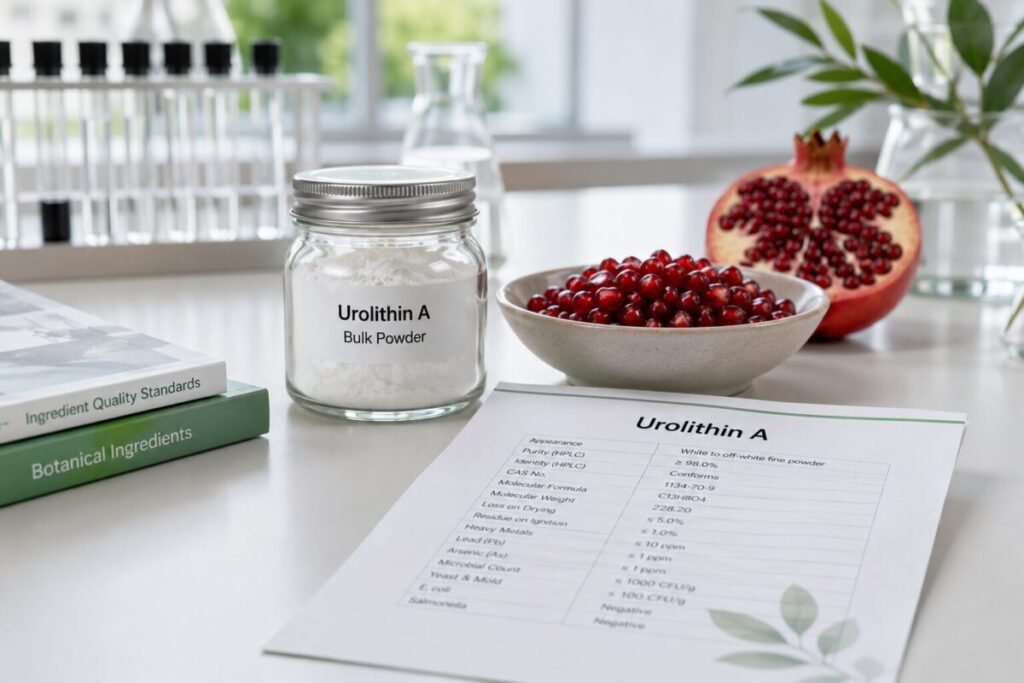
Urolithin A and pomegranate extract are related in the same conversation, but they are not the same ingredient choice.
For supplement brands, the real decision is usually not scientific curiosity. It is formulation fit, sourcing clarity, label story, and how much control you want over the ingredient you put into the formula.
If you are comparing these two routes for a new product line, this guide will help you choose the better fit for your brand, your dosage form, and your documentation needs.
For supplier screening and file review, see How to Qualify a Nutraceutical Ingredient Supplier and How to Verify Supplier COA.
What these two ingredients actually represent
Urolithin A is a defined postbiotic-style compound that is typically discussed as a direct ingredient option.
Pomegranate extract is a botanical ingredient. It can bring a broader plant-based story and contains ellagitannins that some gut microbiota can transform into urolithins, but that conversion varies from person to person.
That difference matters. One is a more direct ingredient route. The other is a botanical route with a wider label story.
For a practical supplier angle, see the earlier article Urolithin A Supplier: Bulk Powder, COA, Purity and Sample Guide for Supplement Brands.
When Urolithin A is the better choice
Urolithin A is usually the better fit when a brand wants:
- A more specific ingredient story
- A clearer standardized raw-material position
- A cleaner comparison against other specialty actives
- Better control over the final formula narrative
It may also make sense when the brand wants to build around mitochondrial, cellular-health, or longevity positioning without relying on the variability of a botanical conversion step.
When pomegranate extract is the better choice
Pomegranate extract can be the better choice when a brand wants:
- A familiar botanical ingredient
- A broader plant-origin label story
- A more flexible blend component
- A lower-education consumer message
It can also be useful in formulas that want a fruit-based antioxidant story alongside other actives.
The tradeoff is that pomegranate extract is not the same as a direct Urolithin A ingredient. If your formula depends on a defined Urolithin A input, pomegranate extract is not a direct substitute.
What brands should compare before deciding
1. Ingredient identity
Ask whether the formula needs a direct compound or a botanical source.
2. Supply chain clarity
Direct ingredients are often easier to specify batch by batch. Botanical ingredients can offer more story value, but the extract profile and marker compounds should still be checked carefully.
3. Documentation
Both options need documentation, but the review points may differ.
For dietary supplement manufacturing, the FDA expects proper manufacturing and holding controls. Review the FDA pages on Dietary Supplements and CGMPs for Food and Dietary Supplements.
Useful files to request include:
- COA
- Specification sheet
- SDS or MSDS
- Country of origin
- Allergen statement
- Stability note
- Identity testing method
4. Marketing position
If your brand story needs a precise specialty-ingredient angle, Urolithin A may feel cleaner.
If your brand story needs a botanical and familiar consumer cue, pomegranate extract may be easier to explain.
5. Dosage form fit
Before you choose, ask how each ingredient behaves in:
- Capsules
- Tablets
- Stick packs
- Powders
- Blends
The best choice is often the one that fits both the formula and the production reality.
Simple decision guide
Use Urolithin A when you want:
- A direct ingredient
- A more specific functional story
- Easier formula positioning
Use pomegranate extract when you want:
- A botanical base
- A broader fruit story
- Easier consumer familiarity
If you want both brand clarity and sourcing discipline, compare them with the same checklist instead of choosing only by name recognition.
Buyer checklist
Before you approve either ingredient, ask:
- What exactly is the ingredient identity?
- What is the assay or marker profile?
- Can I review the COA before purchase?
- Is the sample representative of bulk material?
- What is the MOQ?
- What is the lead time?
- How should the ingredient be stored?
- Which dosage forms are supported?
- What claims are safe for the finished formula?
Recommended internal links
- Urolithin A supplier guide
- How to Qualify a Nutraceutical Ingredient Supplier
- How to Verify Supplier COA
- Ingredient Library
- Ingredient Platforms
- Contact Us
External references
- PubMed: Urolithin A first-in-human trial
- PubMed: Urolithin A and muscle endurance
- PubMed: Crosstalk between dietary pomegranate and gut microbiota
- PubMed: Urolithin A induces mitophagy
- FDA Dietary Supplements
FAQ
Is pomegranate extract the same as Urolithin A?
No. Pomegranate extract is a botanical ingredient. Urolithin A is a defined compound used as a direct ingredient.
Can every person convert pomegranate compounds into Urolithin A?
No. Conversion depends on the gut microbiota and varies across individuals.
Which one is easier to position in a supplement formula?
That depends on the brand story. Urolithin A is usually more specific; pomegranate extract is usually more familiar.
Which one is better for documentation review?
Both need review. The right choice depends on your formula, supplier, and market requirements.
Conclusion
For supplement brands, Urolithin A and pomegranate extract are different tools for different jobs.
If you need a more defined specialty ingredient, Urolithin A is often the cleaner route. If you want a botanical ingredient with a familiar consumer story, pomegranate extract may fit better.
The best decision is the one that matches your formula, your label, and your supplier files.