

For centuries, healers have applied natural products to disease prevention and treatment. Indeed, these compounds remain a crucial resource for traditional medicine and modern drug development. Statistics indicate that researchers have used over 485 medicinal plant species to treat arthritis. Recently, scientists confirmed that many natural compounds possess anti-inflammatory and immunomodulatory activities. Furthermore, these compounds offer advantages like low toxicity, cost-effectiveness, and wide accessibility. However, experts have not yet fully explored the potential of natural products in the prevention of rheumatoid arthritis (RA).
Research Hypothesis: The cfDNA–TREX1 Axis
Previously, our team concluded that circulating free DNA (cfDNA) drives RA pathogenesis. Consequently, we proposed a scientific hypothesis: compounds that promote cfDNA clearance by activating the TREX1 exonuclease may treat RA effectively. To validate this, the team conducted high-throughput screening of more than 2,000 bioactive natural compounds. Ultimately, we identified two TREX1 activators: pterostilbene (PTE) and bilobalide (BB).
Properties of PTE and BB
PTE is a non-flavonoid polyphenol found in blueberries and grapes. Compared with resveratrol, PTE exhibits superior bioavailability and metabolic stability. Moreover, BB is a sesquiterpene extracted from Ginkgo biloba leaves. Academic communities recognize BB for its neuroprotective and antioxidant activities. In this study, we focused on these compounds to explore their potential in activating TREX1 for RA management.
Scientific Breakthroughs in Pharmacological Research
On June 13, 2025, Professor Jinwei Huang and Professor Wanjun Luo from Macau University of Science and Technology published a paper in Pharmacological Research (Impact Factor 10.5). They centered their research on the “cfDNA–TREX1–immune inflammation pathway.” This study reports several key findings:
- Researchers identified PTE and BB as novel natural activators of TREX1.
- TREX1 activation reduces cfDNA levels and inhibits immune responses.
- PTE and BB effectively alleviate joint swelling in adjuvant-induced arthritis (AIA) rat models.
- Combined use exhibits a synergistic effect, enhancing cfDNA clearance efficiency.

The Challenge of Current RA Treatments
Rheumatoid arthritis (RA) is a chronic autoimmune disease. It features systemic inflammation and progressive joint destruction. Clinical experts currently utilize traditional disease-modifying antirheumatic drugs (DMARDs) and biological agents. Although these provide therapeutic benefits, they often trigger drug resistance. Furthermore, long-term use frequently causes significant adverse effects. Therefore, we view the abnormal accumulation of cfDNA as a key pathogenic factor that promotes immune dysregulation. TREX1 plays a key role as a 3′-5′ exonuclease responsible for degrading cytoplasmic DNA fragments.
High-Throughput Screening of TREX1 Activators
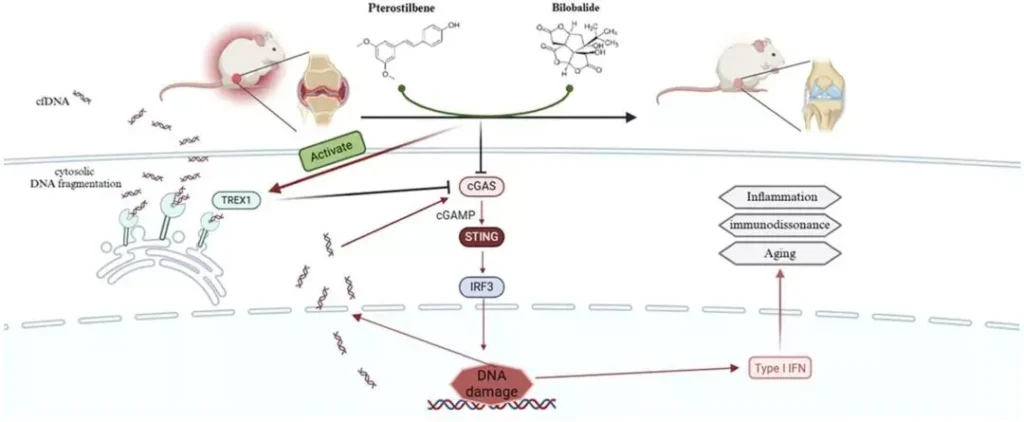
The team used a TREX1 promoter luciferase reporter system to screen over 2,000 natural active monomers. We successfully identified PTE and BB as having TREX1 activation potential. Subsequent experiments confirmed that both compounds upregulate TREX1 expression and enhance its exonuclease activity. In vitro, these compounds increased TREX1 protein expression. Consequently, they efficiently promoted cfDNA degradation and downregulated cGAS-STING pathway activity. This process significantly reduced inflammatory factors like IL-6, IL-8, and IFN-β.
Animal Model Efficacy and Mechanism
Researchers administered PTE or BB orally to AIA rat models continuously. This treatment resulted in improved joint swelling and reduced inflammation scores. Furthermore, micro-CT imaging confirmed significant improvements in bone structure. As expected, TREX1 expression increased, while cGAS levels and peripheral blood cfDNA content decreased.
In TREX1 conditional knockout models, the therapeutic effects of PTE and BB attenuated significantly. This result confirms that the therapeutic success of PTE and BB depends on the TREX1 pathway. For more details on RA pathology, you can check the Arthritis Foundation research portal.
Synergistic Effects of Combined Medication
Based on the common mechanism of “activating TREX1,” PTE and BB exhibited significant synergistic effects. In both in vitro and in vivo experiments, combined treatment inhibited inflammatory responses more efficiently than monotherapy. This finding provides experimental evidence for combined medication strategies. It also demonstrates promising prospects for clinical translation in treating autoimmune diseases.
Conclusion and Future Outlook
In summary, this study confirms that PTE and BB are novel TREX1 activators. They alleviate RA symptoms by promoting cfDNA clearance. The synergistic effect of their combined use enhances therapeutic efficacy and may reduce clinical dosage. These findings provide evidence for TREX1-targeted therapies. Finally, they lay a foundation for applying natural compounds to age-related inflammatory diseases. We believe this strategy holds broad reference significance for other autoimmune conditions.
Important Reminder: All content in this article is for general reference only. Descriptions related to efficacy are supported by data, but they do not represent claims for consumers. Please consult professional medical institutions for medical advice. This article provides no medical recommendations.