
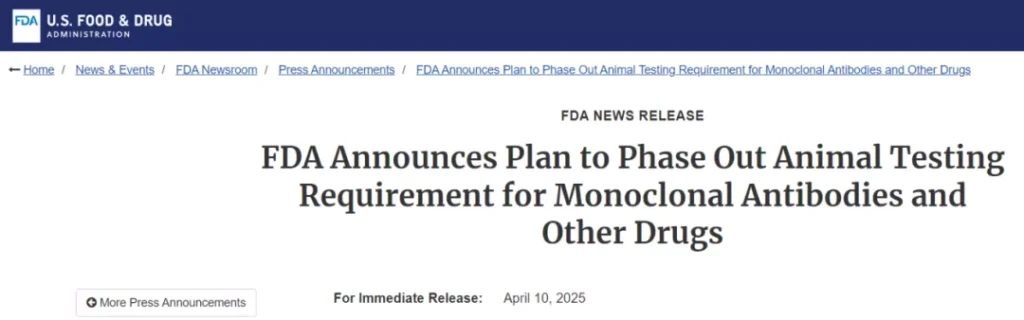
On April 10, 2025, the U.S. Food and Drug Administration (FDA) officially launched a plan to reduce animal testing in preclinical safety studies. The agency has now incorporated this initiative into the Investigational New Drug (IND) application process.
This new policy clearly states that the FDA will gradually eliminate mandatory animal testing requirements for monoclonal antibodies and other drugs. Instead, developers will use “new approach methodologies” (NAMs) to obtain experimental data. These non-animal methods include artificial intelligence (AI) computational models, human cell lines, organoids, and organ-on-a-chip systems.
Dr. Martin A. Makary, Commissioner of the FDA, highlighted the benefits of this shift: “By relying on AI computational models, laboratory tests using human organ models, and real-world human data, we can accelerate the provision of safer treatment options for patients. These technologies also reduce drug development costs and drug prices. This shift holds dual positive significance for public health and ethical development.”
The Evolution of FDA Policy
Looking back at the policy background, the United States passed the FDA Modernization Act 2.0 in September 2022. This act repealed the requirement for mandatory animal testing before human clinical trials of new drugs. It laid a solid foundation for using non-animal alternative solutions, such as AI models and organoid chips, in IND applications.
Now, the FDA is further promoting the implementation of this policy. Simultaneously, the agency released its Roadmap for Reducing Animal Testing in Preclinical Safety Studies. This roadmap clarifies the implementation path through scientifically validated NAMs technologies. These include organ-on-a-chip systems, computational modeling, and advanced in vitro testing. Finally, the document emphasizes the importance of multi-institutional collaboration to drive this transition.
Official Recognition of Alternative Tech
In August 2022, the FDA approved the world’s first new drug to enter clinical trials using preclinical data primarily from “organ-on-a-chip” research, registered under clinical trial number NCT04658472. This historic milestone marked the official recognition of non-animal alternative technologies.
Against this backdrop, domestic and foreign enterprises have successively increased investment in human organoids, organ-on-a-chips, and AI simulation tests. For example, MCE Corporation signed a strategic cooperation agreement with the School of Pharmacy at Shanghai Jiao Tong University. They will carry out in-depth cooperation around “AI + organoids + drug research and development.” Together, they are building a national-level intelligent organoid drug research strategic platform to promote industrial technological upgrading.
1. Human Organoid Technology: A Key Bridge Connecting Traditional Culture and Animal Models
Technological Development History
The concept of organoids first emerged in 1997. However, organoid research achieved a true breakthrough in 2009. Hans Clevers and his team from the Netherlands Cancer Institute (NKI) successfully developed the first “complete” organoid model: the artificial intestinal organoid.
In 2011, the same team constructed a colorectal cancer organoid model using tumor tissue from actual patients. This milestone expanded the application of organoids into oncology research. Currently, patient-derived organoid (PDO) models represent a major trend in cancer studies. In 2019, the journal Science featured organoid research on its cover and selected it as a major breakthrough of the year. This accolade demonstrated its vital position in the life sciences.
Technical Definition and Core Advantages
Organoids are a type of self-organizing cell culture that can simulate the structure and function of natural organs. Scientists can induce and generate them from adult tissue stem cells or pluripotent stem cells. Common examples include liver organoids and intestinal organoids.
As a key bridge between traditional 2D cell cultures and live animal models, organoids possess both experimental operability and biological complexity. Researchers have verified their core advantages by comparing them directly with 2D cell cultures and animal research (see Table 1).
Table 1: Comparison of Organoid Culture, Two-Dimensional Cell Culture, and Animal Research
(Note: Data evaluated based on the comprehensive framework outlined in Organoids – Preclinical Models of Human Disease.)
| Evaluation Dimension | 2D Cell Culture | 3D Organoids | Animal Models |
|---|---|---|---|
| Physiological Characterization | Limited | Semi-physiological | Physiological |
| Vascularization & Immune System | No | No | Yes |
| High-Throughput Screening | Yes | Yes | No |
| Operability | Excellent | Good, but variations exist | Limited |
| Biobank | Yes | Yes, but cellular level | No |
| Genome Editing | Yes | Yes | Yes, but requires embryonic stem cells |
| Organogenesis Modeling | Poor | Suitable for cell communication | Yes, but affected by complex environment |
| Human Development & Disease Modeling | Poor, due to over-simplified conditions | Yes | Yes |
Technical Preparation of Human Organoids
There are two main approaches for the preparation of human organoids. First, technicians can extract cells from normal or malignant primary tissues. They then induce organoid generation using the R-spondin method, which is a basic technology for making intestinal organoids. Second, researchers can reprogram somatic cells into induced pluripotent stem cells (iPSCs). They then use directed differentiation technology to obtain organoids that cover the three germ layers.
Currently, developers have deeply integrated organoid technology with other cutting-edge methods. These include genome editing, single-cell genomics, live-cell imaging, and microfluidic technology.
Modern Application Scenarios
Today, laboratories widely apply organoids in several fields:
- Disease modeling
- Anti-cancer drug screening
- Drug toxicity identification
- Genetic testing
- Cell therapy research and development
This technology provides a fresh perspective for analyzing organ development and disease pathogenesis. At the same time, it significantly accelerates the development of disease diagnosis technologies and treatment plans.
Key Technical Operation Points
Sample Processing Best Practices
Laboratories should prioritize fresh surgical or biopsy samples. If technicians require cryopreservation, they must use special cryopreservation solutions. Furthermore, shipping teams must use special reagents during transportation to maintain cell viability.
Staff can store samples at 4°C for no more than 24 hours. For long-term storage, place them in a -80°C environment or liquid nitrogen, though cell viability may decrease after resuscitation. Technicians should wash samples with medium or PBS to remove blood, mucus, and debris. We highly recommend performing this step in an ice bath. For high-pollution samples like intestinal and tumor tissues, add 1% penicillin-streptomycin (P/S) to prevent contamination.
Tissue Digestion and Handling
First, cut the cleaned samples into appropriate sizes. Next, select collagenase IV (mild type), trypsin (potent type), or commercial digestive solutions according to your specific needs. Lab technicians must observe the digestion status every 5 minutes to avoid over-digestion. Finally, use a serum-free stop solution to terminate digestion. This prevents unknown components in fetal bovine serum (FBS) from interfering with the sample.
Culture, Passage, and Resuscitation
Thaw Matrigel in advance and operate strictly on ice because it solidifies quickly at room temperature. Optimize the cell seeding density with reference to current literature, and use special medium to provide the substances required for growth and differentiation.
After organoids grow fully or mature, use gentle pipetting or short-term digestion for separation and passage. For cryopreserved organoids, select cells with good viability after 2 to 3 passages. Keep the cryopreservation density at or above 2×10⁵/mL. During resuscitation, perform rapid thawing in a 37°C water bath to avoid the cell damage associated with slow thawing.
Modern Detection Methods
For cell viability detection, technicians can use 3D and organoid ATP detection reagents along with standard viability detection reagents. For phenotypic identification, combine DAPI nuclear staining with specific marker recognition to achieve a truly multi-dimensional analysis.
2. Organ-on-a-Chip System: A Cutting-Edge Technology for Microphysiological Environment Simulation
Technological Development Background
Following the approval of the NCT04658472 new drug clinical trial, organ-on-a-chip technology has become a primary focus of the pharmaceutical industry. This system relies on a microphysiological system (MPS), which uses microfluidic technology to realize multi-organ linkage.
As a miniaturized bioengineering system, this technology cultures cells or tissues inside microfluidic chips. It integrates multiple disciplines, including biology, materials science, and engineering. Relying on microfluidic equipment (such as microscopes and lens-free microscopes) and monitoring systems (such as actuators, sensors, and biosensors), the technology realizes real-time monitoring of cell growth and precise regulation of the culture microenvironment.
Technical Structure and Core Components
Organ-on-a-Chips (OOC) mainly consist of three core parts:
- Microchannel Structures: These structures simulate the natural organ tissue environment. They provide space for cell attachment, growth, and interaction.
- Living Cell Systems: These systems incorporate cells like stem cells, which technicians culture directly inside the microchannels or pore structures.
- Bionic Environment Systems: These systems simulate the physiological environment of living organs. They do this by precisely controlling nutrient supply, oxygen concentration, and liquid flow conditions.
Take the scaffold-free bone marrow chip as an example. Its structure includes a glass layer for real-time microscopic observation. It also features three polydimethylsiloxane (PDMS) layers that house the upper cell culture microchamber. This chamber sits separate from the lower medium perfusion channel, allowing material exchange through an intermediate porous membrane (see Figure 1).
(Note: Figure 1 illustrates the cross-section of a scaffold-free bone marrow chip. It includes a glass observation layer, three PDMS layers, an upper cell culture microchamber, a lower medium perfusion channel, and an intermediate porous membrane.)
Technical Advantages Over Animal Models
Compared with standard organoid technology, organ-on-a-chip systems further integrate microfluidic, mechanical force, and multi-cell co-culture technologies. This allows a more accurate simulation of the live physiological environment. For example, a human liver chip can co-culture hepatocytes and non-parenchymal cells under continuous perfusion conditions. The resulting model exhibits metabolic functions and response characteristics highly similar to a real human liver. It can capture human-specific biological effects that animal models simply cannot simulate.
Overall, organ-on-a-chip technology offers five core advantages to drug developers:
- Animal Replacement: It reduces and ultimately replaces animal testing by constructing highly reproducible human models. This supports high-throughput screening, reduces R&D costs, and improves experimental efficiency.
- Personalized Testing: By integrating a patient’s own cells, clinicians can monitor drug responses, effectiveness, and toxicity in real time to accurately identify biomarkers.
- Medical Testing Suitability: Because of its small size and high automation, teams can apply it to point-of-care diagnosis to achieve decentralized testing.
- Parallel Testing Capabilities: Operators can integrate multiple detection items on the same chip without relying on complex, expensive instruments.
- Advanced Drug Delivery: It facilitates toxicity testing and human disease modeling. This allows researchers to evaluate the targeted drug delivery effects of carriers like nanoparticles while simultaneously detecting drug efficacy.
The Rise of Human-on-a-Chip Systems
At present, bioengineers have developed many types of organ-on-a-chips. These include brain, bone, kidney, lung, pancreas, heart, and stomach chips. Furthermore, this research has birthed human-on-a-chip technology. These advanced systems simulate the functions of multiple human organs within connected microfluidic devices.
Human-on-a-chip technology is highly complex. It requires the integration of 2 to 10 distinct organ modules. It also requires complex microfluidic channels and precise, automated processing systems. Technicians culture cells from different organ sources in separate chambers and simulate blood circulation through a circulating medium. This allows deep multi-organ physiology research. Consequently, it can predict the impact of drugs on target organs and analyze potential side effects on other organs at the same time.
Technical Application Case
In April 2022, John W. Rumsey and his team published a breakthrough study detailing the first human-on-a-chip (HoaC) electrical conduction model. Their paper, titled Classical Complement Pathway Inhibition in a “Human-On-A-Chip” Model of Autoimmune Demyelinating Neuropathies, showed how they designed this model specifically to study chronic inflammatory demyelinating polyneuropathy (CIDP) and multifocal motor neuropathy (MMN) (see Figure 2).
(Note: Figure 2 shows this new in vitro human-on-a-chip system. It includes motor neurons derived from human induced pluripotent stem cells (iPSCs), human Schwann cells, and a microelectrode array (MEA). The MEA features channels to guide axon growth directly to the electrodes.)
This model guides axon growth using a microelectrode array. After the team added patient serum, the model exhibited a clear disease phenotype, including decreased motor neuron action potential frequency and slowed conduction velocity. However, treatment with TNT005—a murine monoclonal antibody that inhibits the key protease C1s—significantly improved the serum-induced complement deposition and functional defects. The data from this model provided key support for preclinical tests during the NCT04658472 clinical trial. Ultimately, this data helped the new drug pass FDA approval and enter the clinical trial phase without traditional animal data.
3. Advanced Computer Simulation Technology: A Digital Tool for Drug Behavior Prediction
In its newly released roadmap, the FDA clearly encourages developers to use computer modeling and AI technologies to predict drug behavior. Currently, the core computer simulation tools fall into four main categories.
Physiologically Based Pharmacokinetic (PBPK) Modeling
PBPK models use species-specific physiological parameters to mathematically simulate the absorption, distribution, metabolism, and excretion (ADME) processes of drugs. These models can accurately predict the pharmacokinetic characteristics of drugs across different species. This data provides a scientific basis for clinical dose design and inter-species dose conversion.
Machine Learning and AI Prediction Models
Developers can train machine learning algorithms using drug sequence features, structural motifs, and known clinical results. Currently developed models can predict the immunogenicity of monoclonal antibodies by analyzing the amino acid sequence of the antibody variable region. This approach provides a fast, efficient detection method for the immunological safety evaluation of antibody drugs.
Quantitative Systems Pharmacology (QSP)
QSP models integrate computational biology and pharmacology theories to simulate the interaction between drugs and complex human biological networks. For example, in autoimmune disease research, QSP models can simulate how antibodies regulate inflammatory pathways.
This allows scientists to predict effective dose ranges and potential toxicity risks, such as excessive suppression of the immune system. By constructing a “virtual human body” to test different experimental scenarios, developers significantly reduce their reliance on animal disease models.
Bioinformatics and In Silico Off-Target Screening
Relying on human protein databases and AI technologies, researchers can screen for potential unintended targets in drug sequences, such as cross-reactivity with human tissues. This technology identifies potential safety hazards by analyzing how drugs bind to similar epitopes in the human proteome.
This digital screening replaces traditional animal tissue cross-reactivity studies and extensive receptor binding panels. As a result, it improves both the efficiency and accuracy of drug safety evaluations.
Conclusion
In summary, computer simulation technology forms an important part of natural approach methodologies (NAMs). It predicts human-relevant experimental results through data integration and modeling analysis. It has become an essential supplement and alternative tool for animal research, providing key support for digital, precise drug development.7] Roadmap to Reducing Animal Testing in Preclinical Safety Studies.